











As the RCP celebrates the 60th anniversary of the founding of the Journal of the Royal College of Physicians of London (now Clinical Medicine) and Commentary, Harveian librarian Professor Anita Simonds examines college life, the changing NHS, health policy and concerns in medicine and training in 1966.
The first edition was published in October 1966. This was a year of huge national highs – England won the World Cup, London was in the midst of the ‘swinging sixties’ – but also of terrible lows – the Aberfan disaster, a sterling crisis and pay freeze.
On a background thrum of examinations, Council meetings and officer elections, what were the activities and ambitions of the RCP in 1966? How did these link to developments in the fledgling NHS, current news, and wider health and science policy?
By early 1966, Edward Charles Dodds had been RCP president since 1962 and had overseen the momentous move of the college from the clubby atmosphere of Pall Mall East to its expansive Lasdun-designed home in Regent’s Park in 1964, the project having been commissioned by his predecessor Robert Platt. Dodds had been a break from tradition – the first laboratory-based RCP president, as a biochemist. He was succeeded in April 1966 by Max Rosenheim, a renal physician.
NHS and political context
In 1966, the NHS was expanding rapidly. UK health spending as a proportion of GDP was at 3.5%, rising to 4% in 1967 (compared with 11% today). A Labour government had been returned with an increased majority, following a snap election in March 1966. This enabled health minister Kenneth Robinson to embark on a series of pressing reforms, which had not been possible after Harold Wilson’s 1964 narrow victory.
Serious organisational dilemmas had to be tackled which had a direct impact on hospital care and the physicians that the RCP represented. Robinson worked with GPs and the British Medical Association (BMA) to negotiate a family doctor charter, which later developed into the GP contract. A burst of new health centres swiftly followed.

For hospital consultants, Robinson negotiated with the profession to accept a reduction in hospital beds, but lifted the cap on consultant fees. The RCP’s role in these deliberations derived from its permanent representation on the Joint Consultants Committee (JCC), alongside the BMA. As a next step, the Cogwheel Report was set in motion between government and the JCC, with RCP registrar Kenneth Robson working with the chief medical officer (CMO) Sir George Godber. The aims of this report were to rationalise coordination between hospitals, general practice and local authorities – and resolve problems with a lack of trust between doctors and hospital management. At the same time, the Salmon report provided a new career advancement structure for senior nurses. These organisational changes are recognisable in hospital structures today.
There were major societal changes afoot too – in the 60s, the public was becoming less deferential to authority and patients wanted a stronger voice in their own care. Wilson had delivered his ‘White heat of technology’ speech in 1963, and new reports on medical research were multiplying. The need to disseminate rapidly evolving medical developments to its members, and for doctors to communicate these to patients, was an important rationale for the RCP to start a new journal.
Training and career pathway reform
Rosenheim had a major interest in training reform and made this a priority. In 1966, the RCP began an official process to accredit hospital posts for consultants in training, producing standardised training schedules and laying out a structured programme. New formats for continuing medical education were initiated, including ‘teach-ins’, ‘growing points in medicine’ and Christmas lectures for children.
The MRCP (London) examination dated from the previous century, in 1859. A major revision in 1963 modernised the content, converting Part 1 to multiple choice questions, with Part 2 comprising written/clinical/orals sections. Rosenheim and the RCP then collaborated with the Royal Colleges of Physicians of Edinburgh and Glasgow to produce a unified MRCP(UK) qualification, and Part 1 was now offered in some overseas centres.
In Rosenheim’s obituary, Kenneth Robson describes how he set up the network of regional advisers to spread RCP news to local hospital teams and keep the college in touch with physicians on the ground. Rosenheim added 1,000 new fellows during his tenure, which aligns favourably with the rapidly increasing number of hospital physicians throughout the 1960s.
The RCP’s ideas on structuring medical training were extensively fed into the government’s Todd Commission (Royal Commission on Medical Education) which was taking evidence throughout 1966; these proposals shaped its 1968 conclusions. For undergraduate training, the recommendations were for a 5-year undergraduate course to include behavioural science, genetics, epidemiology and statistics. The widened curriculum scope was to be achieved by shortening anatomy teaching, with a shift towards continuous assessment and a modular course structure.
Todd also recommended major medical school expansion – with the goal of doubling the national output of doctors by 1975 – and further integration of London medical schools into the University of London. In addition, teaching hospitals were to be brought within the regional NHS hospital structure. He also recommended the creation of the future Faculty of Community Medicine (now the Faculty of Public Health).
The RCP’s emphasis throughout was on standardisation of examinations and ensuring the high quality of hospital posts.
Not surprisingly, committee membership and leadership roles in 1966 were dominated by male fellows, reflecting the gender balance throughout medicine at this time. It is difficult to obtain exact figures, but during the 1960s women constituted approximately 25% of medical students – a 1944–73 quota system required medical schools to have a female intake of at least 15%. By 1965 around 21% of hospital doctors were female, concentrated in only a handful of specialties. Women consultants were notably fewer – probably in the low single digits as a percentage.
Health policy advocacy
1966 stands at the intersection of several key strategic policies being implemented and developed, with the RCP’s influence on health policy growing. One senses optimism and a greater sense of positivity in the air as noted by historian Asa Briggs in his volume of History of the Royal College of Physicians, as the new college environment invited fresh thinking and a more outward vision.
In March 1962, the RCP had published the important and influential Smoking and health report, as discussed recently in Commentary. While evidence of the hugely harmful effects of smoking had been gathering since 1950, the RCP was able to powerfully collate the subsequent large volume of evidence. Importantly, the report had been launched with the RCP’s first ever press conference, gaining wide attention with its direct approach to the public. By creating a clear agenda for action, government uptake was triggered.
And so, in 1965, legislation banning cigarette advertising on television was introduced, and 1966 saw public health campaigns on the effects on smoking. Bans of advertising outside of television, restriction on sales, packet warnings, increases in taxation, smoking bans in public places and more decisive legislation would evolve over decades – but it was a start. There is a clear throughline to today, with publication of the RCP’s 2026 report, Smoking, health and social justice.

This policy work in the mid-1960s marked a rise in prominence of the RCP’s part in setting the agenda on government health policy; such as dealing with the uncertain state of ethical supervision in medical research, which was becoming a hot topic after the 1964 Declaration of Helsinki, a foundational document on human research ethics, focusing on the principle of informed consent.
Here the RCP was on the front foot, the issue having been raised with the president by a triumvirate of fellows (DR Laurence, F Avery Jones and AC Dornhorst) in September 1966. The college was in an ideal position to translate principles into clinical practice, as its members were both researchers and clinicians. Rosenheim regarded this as ‘a responsibility to the public the College cannot shirk’ and immediately set up a committee (its trusted modus operandi), chairing it himself and working with the CMO and health minister.
As committee work progressed, a 1967 exposé on human experimentation in trials without consent was published by M H Pappworth. This lead to a public furore and a headline in The Sun: ‘Wolves in white coats.’ There was friction across the medical establishment, as malpractice was identified by Pappworth and others in NHS hospitals. This was a sign of greater scrutiny of medicine, with the public moving away from the longstanding belief that ‘doctors could do no wrong’. Notably, the first patients’ representative body, the Patients Association was formed in 1963.
This heightened awareness gave urgency to the RCP’s 1967 report, Supervision of the ethics of clinical investigations in institutions, with recommendations for the formation of Research Ethics Committees (RECs) within hospitals to oversee clinical trials and investigations. These recommendations were rapidly taken up with the Ministry of Health, which published 25,000 copies and sent the report to 8,000 consultants across England. Although implementation was bumpy, within 6 years, the number of RECs rose from 0 to 238 – covering all teaching hospitals and 70% of other hospitals.
In other areas, in 1966 the RCP began work on its 1969 report Brain damage in boxers, which found that 17% of retired professional boxers had evidence of chronic brain damage – with injury more common in those who had fought for longer, or who had lost bouts by knockout. The report was cited in the 1973 House of Lords debate, justifying restrictions that boys should not box without parents’ informed consent, and that parents should be told of the risk of brain damage. There were other diverse reports published including on social and preventive medicine, psychological medicine, care of the health of hospital staff, accidental hypothermia and paediatric neurology.
The RCP calendar of events
RCP events in 1966 had the same recognisable pattern and focal points to the calendar in 2026, although there were far fewer courses and teaching activities. The Harveian Oration that year was given by Macdonald Critchley on ‘The divine banquet of the brain’ and the FitzPatrick lecture was presented by Sir Geoffrey Langdon Keynes on ‘John Woodall, surgeon 1556–1643: his place in medical history’.
The Archive and museum activities were then subsumed within the RCP Library team, and major exhibitions were not yet mounted, but the Annals note there was a July 1966 display on ‘Ars sphygmica; the ancient art of feeling the pulse’.
The first edition of the journal
Returning to Clinical Medicine, its first editor (Adair) Stuart Mason was asked personally by Rosenheim to initiate the new quarterly journal, including designing and supervising the layout, style and printing. Mason himself was a figure bridging the period between World War II and the 1960s – which he had in common with many college officers at the time. Having qualified in medicine in 1943, he was the duty casualty officer at the London Hospital on the night of the Bethnal Green tube disaster, when 173 people died in a crush in the underground station during an air raid. He provided a personal editorial for each journal edition, which he edited for 21 years, and founded Clinical Endocrinology in 1972.
Surprisingly, not all senior fellows saw the immediate merits of a new journal in 1966 – historian Asa Briggs reported that the future president, Douglas Black, had ‘qualms’ but was won over by Mason; some 10 years later, he congratulated him on his wise editorial policy.
With great foresight, Mason presented the journal ‘as a commentary on the whole medical scene …. dedicated to plain speaking, because inflation has debased the printed word and jargon alienated the enquiring reader’. The aim was to unite the fellows and give them a sense of belonging at a time when ‘medicine was tending to fragment’ with diverging specialties.
The first edition included advertisements targeted to both physicians and GPs on antibiotics, antifungals, oral antidiabetic therapy and antidepressant medication. The advertisement for the monoamine oxidase inhibitor ‘Nardil’ – ‘specifically for neurotic depression’ – illustrated by a harried-looking female supermarket shopper, hints powerfully of attitudes at the time.
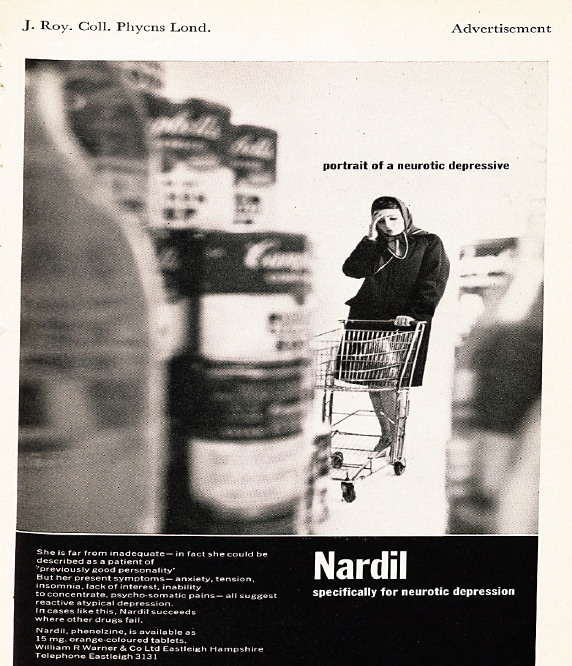
Advertisement for Phenelzine (Nardil), an antidepressant, in the first edition of the journal.
The journal also included an insert with updates on college life – the first edition of Commentary, which would later evolve into the RCP’s membership magazine.
In summary, 1966 is a blink in the 500-year history of the RCP but on the anniversary of the journal, the mid-1960s can be seen as a hinge point ushering in a confident phase. There was the recognition that postgraduate education had to be better organised, that the RCP could play an important role in setting the agenda on health priorities (including ethical matters), and it had a responsibility to reach out to patients as the NHS rapidly expanded. The journal was part of its ongoing work to support its members and fellows in staying abreast of the rapid advances in medicine.
Professor Anita K Simonds
Harveian librarian