

















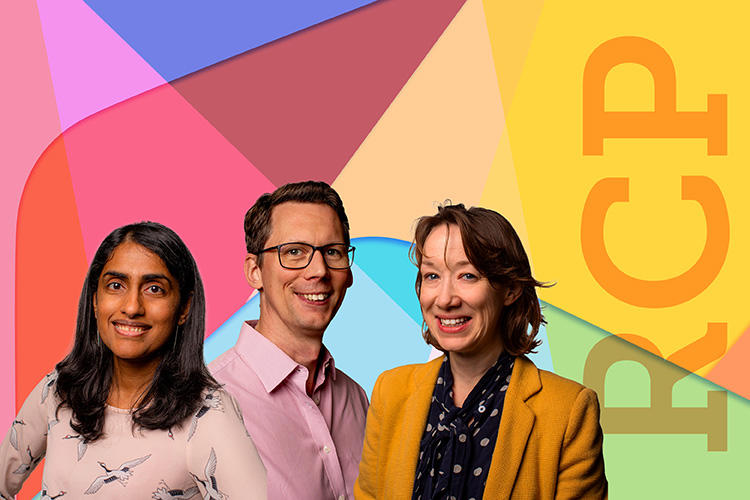





Dr Charly Annesley is a consultant geriatrician and learning disability specialist. To celebrate International Women's Day in March 2026, she speaks with Commentary about her work as the first UK consultant learning disability physician, focusing on optimising the physical health needs of adults of all ages with a learning disability.
In 2019, Charly helped create the first NHS post, drawing inspiration from the Netherlands where the role already existed.
She is also the course lead for the postgraduate certificate, Meeting the medical needs of adults with a learning disability, which she helped launch in 2023. She co-designed and runs the course with an expert faculty – working closely with experts by experience, the RCP and Edge Hill University. The course aims to champion high-quality care for adults with a learning disability and to equip senior doctors, nurses and allied health professionals with the skills to provide excellent patient-centred care through effective clinical practice and leadership.
Charly has worked on creating a number of national guidelines, eg NHS England Guidance to support implementation of the Mental Capacity Act in acute trusts for adults with a learning disability (2025) and the British Thoracic Society Clinical statement on the prevention and management of community-acquired pneumonia in people with learning disability (2023). She is a passionate advocate for improving acute medical care standards for people with a learning disability. She also works with the Emerging Women Leaders Programme, providing talks and mentorship, to inspire the next generation of female leaders in medicine. She lives in north London with her husband, two daughters and a rescue cat.
Your leadership journey has been one led by passion for something different. Why did you decide to create a new job role instead of following an already walked path?
Charly: In my first year of work, I learned about Dr Marjorie Warren – often called the mother of geriatrics. Her story was incredibly inspirational because she didn’t just follow the existing system; she reshaped it. She identified inequality and transformed the way that older people are seen and supported in the healthcare system, creating radical change for treatable and preventable illnesses. That idea stayed with me.
At the same time, I found so much joy in working with people with a learning disability in different settings. So, combining that passion with the possibility of cultural change led me to create a role that didn’t previously exist. It was a risk, but there is so much that needs to be done to improve healthcare outcomes for people with a learning disability – and honestly, I feel like I’ve got the best job in the world.
What leadership skills do you value in yourself? Does your approach to leadership complement your specialty?
Charly: Medical training teaches the classic assertive leadership skills – being steely, tenacious, decisive. Those skills matter and I have developed those, but the skills I value most are the ones we don’t always revere; listening deeply, remaining calm, being fair, respectful and approachable.
These are crucial when working with people with a learning disability and their families/carers, who are the experts on the person – they know them better than I ever could. Leadership, for me, is about listening rather than being the loudest voice in the room.

The skills that make the biggest difference aren’t always the ones we celebrate.
Dr Charly Annesley
UK consultant learning disability physician
Advocacy requires both compassion and assertive challenge. How do you balance these?
Charly: I start with what’s right for the patient. Most of the time, collaboration is easy, and fun. Another great joy of my job is working with so many multidisciplinary colleagues across the whole spectrum of medical specialties. But if I strongly disagree with a decision, I won’t hesitate to challenge it.
I’m in a privileged position because of my niche expertise – I lead a postgraduate course; I’m confident in the evidence base – so I’m well-placed to advocate when needed. That foundation helps me be assertive without becoming adversarial.
Do people ever seem surprised when you use more authoritative leadership skills?
Charly: It’s hard to know why people respond the way they do, but yes – sometimes people assume that the ‘soft skills’ are all I use. They’ll ask, ‘What’s the trick?’ when a difficult case goes well. Often, the answer is those softer skills. But when assertiveness is needed, I use it. It’s just not my starting point. One big potential pitfall is diagnostic overshadowing (attributing a presentation or symptoms as being due to the learning disability, and therefore potentially missing an important treatable diagnosis) – that’s definitely a time for me to step in.
I’m driven by doing the right thing for the person in front of me. Sometimes that means gentle conversation – and sometimes it means challenge.
Dr Charly Annesley
UK consultant learning disability physician
What challenges have you experienced as a woman on your career journey?
Charly: So many. Most women in medicine will recognise them. A major one is being underestimated or doubted. And there’s sometimes a perception that learning disability work is ‘women’s work’, or somehow less important – the ugly truth behind that is both disability discrimination and sexism. That combination can create a sort of double bias.
Being underestimated is a common experience for women in medicine – and even more so in specialties seen as 'less glamorous'.
If you could help others to understand one key thing about your experience, what would it be?
Charly: I love what I do, but I’m aware that many clinicians feel uncomfortable around people with learning disabilities simply because they’ve often had almost no training. I would encourage others to look for training that will support them to understand what they can do to provide patient-centred care for people with a learning disability. It’s useful to push ourselves to get a bit more experience – about 2% of the UK population have a learning disability, so we will meet people in all areas of medicine. We’ve got a duty to make sure that we’re providing equitable care, but on top of this, with a bit more confidence, I’m sure people will start to value this as a really exciting and fun aspect of medicine.
The small things matter; listening, taking family expertise seriously, challenging diagnostic overshadowing. You don’t have to be a specialist to make a huge difference. Anyone can do this work well if they take the time to provide reasonable adjustments (things as simple as a bit of extra time for communication, reading a hospital passport, making sure the person has family member / carer to support them) and keep an open mind.
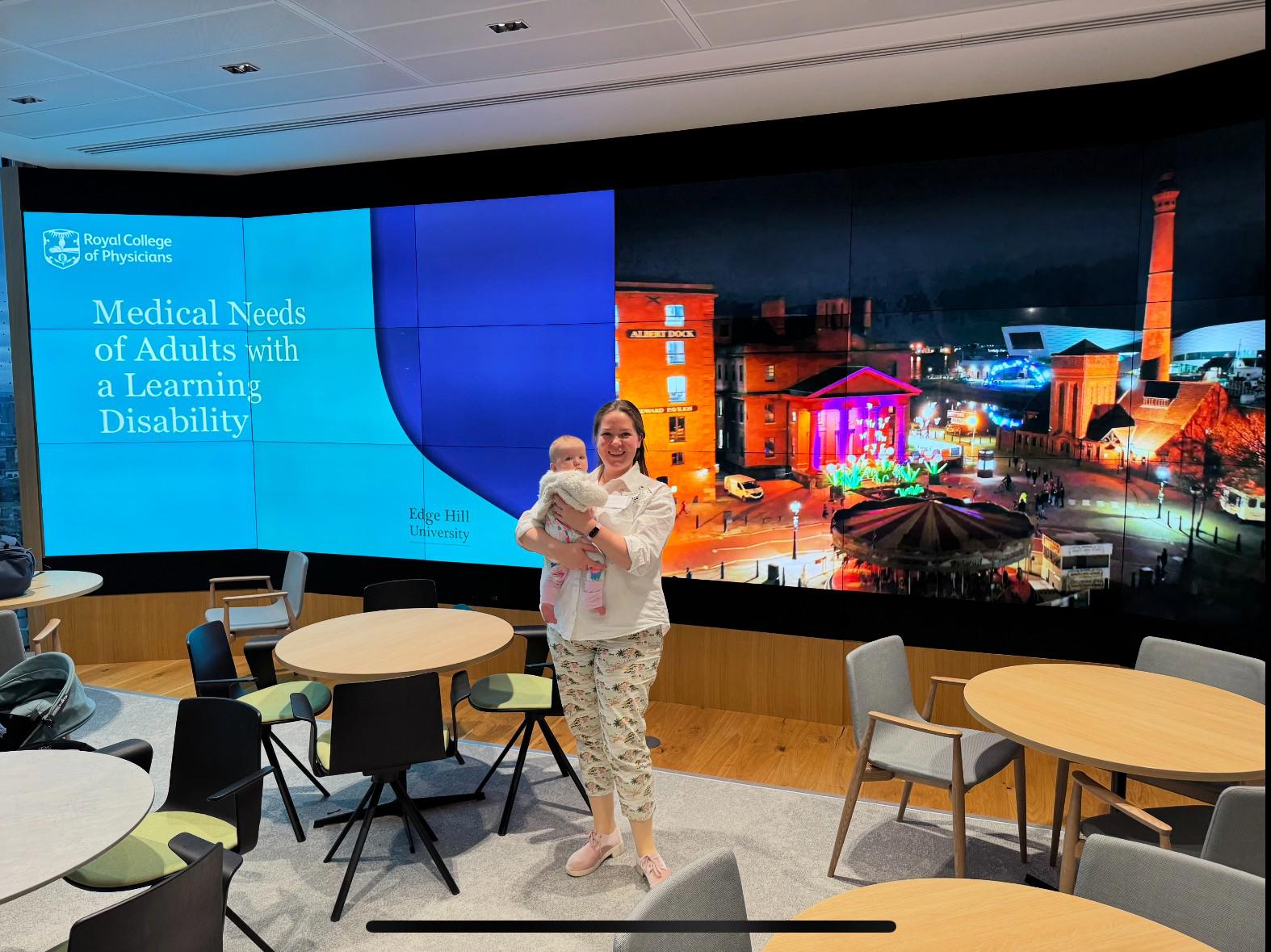
Image: Charly at the RCP at The Spine, Liverpool.
You’ve recently had your second baby. Is there still tension between women’s careers and society’s expectations of caregiving?
Charly: Yes – very much so. And interestingly, if I were a man, you probably wouldn’t ask me this question. My husband and I split childcare 50/50. He’s often praised for being so involved as a dad, while I sometimes get judged both as not doing enough at home and not doing enough at work. I think a lot of people can feel undervalued when working less than full time, but ultimately life is complicated and we’ve all got to work out how to best juggle all our different commitments. When childcare is shared equally, men get praised – and women get questioned.
What can we do to ensure that women are supported, trained and recognised for the value they bring to medicine?
Charly: We need honest conversations – both the easy and the uncomfortable ones. Positive role modelling is powerful, especially showing that there’s no single way to be a woman in medicine.
We must also recognise bias – gender, disability, race, all of it. When making clinical decisions, a question I ask myself often is: ‘Would I make the same decision if this person didn’t have a disability? If they were a man? If they were White?’
It’s a useful way to spot bias in real time. Being aware, being curious, and acting as allies – those are the foundations.
Are there women who inspire you? How have they influenced you?
Charly: I’ve been fortunate to have worked with so many amazing people over the course of my career. I worked with Dr Anine Kritzinger in South Africa back in 2011 – it was an intense and gruelling job in an emergency department, and Anine demonstrated exceptional qualities of leadership as well as attention to detail. She set an incredible example of how to remain calm under real pressure – quite a useful skill in the NHS at the moment!
My former educational supervisor, Dr Sophie Edwards, has also been hugely inspirational to me. I feel that she taught me everything I know about person-centred care and, although she might not realise it, has been a role model in shaping this specialty.

Work on women and leadership can feel like an echo chamber. How do we involve others with different perspectives?
Charly: This is the challenge across all inequalities work. The people who attend the talks, read the reports, take the courses – they’re already engaged. Reaching those who think that it’s not quite relevant to them is the hard part, especially when we are all so busy. For learning disability, for example, there are national reports going back over 20 years that all highlight inequality, and yet not much has changed in terms of clinical outcomes – that was a big driver for creating my role.
Part of it is personal work: recognising that bias sits within all of us. And part of it is structural: one of the most important laws in healthcare is the Equality Act and we have a legal duty to support all protected groups.
Creating allies takes nuance – we must share the difficult truths, but also build relationships without leaving people feeling judged or defensive. In equalities work, the people who show up are usually the ones who already care. The challenge is reaching those who think that it isn’t about them.
