



























Dr George Luiz Welter Corrêa is a consultant gastroenterologist at the Paulista School of Medicine at the Federal University of São Paulo, Brazil. He shares his experience of visiting Kettering General Hospital, Leicester – spending time there with Dr Ajay Verma, RCP fellow and member of the Commentary advisory board.
On my annual trip to Leicester, UK to visit my brother and his family, I had the opportunity to visit Kettering General Hospital and spend some time with Dr Ajay Verma, a consultant gastroenterologist. I observed Ajay’s inflammatory bowel disease (IBD) clinic.
This experience was eye-opening, not only in terms of clinical practice but also in the broader way in which the healthcare system shapes our daily decisions in IBD management. Throughout the clinic, I could observe some marked differences, starting with something as simple as the way we introduce ourselves to patients. In the UK, it was ‘Dr Verma and Dr Correa’ in the room. In Brazil, it would be ‘Dr Ajay and Dr George’.
In Brazil, we have the national health system, SUS (Sistema Único de Saúde), which covers the entire population for free (plus taxes), alongside a smaller private health insurance sector that encompasses roughly 25% of the population. The majority of patients with IBD in the public system face important limitations, particularly regarding drug availability. In contrast, the NHS, despite its own challenges, offers a wider range of biologics and advanced therapies, and patients can access treatments that remain out of reach for many Brazilians.
The therapeutic arsenal
The therapeutic arsenal in Brazil’s public sector is still limited. For Crohn’s disease, we can prescribe infliximab, adalimumab and certolizumab. For ulcerative colitis, the options are infliximab, vedolizumab and tofacitinib. That is essentially the entire spectrum available through the SUS. In the private sector, the drug availability is quite different. Patients have access to other classes of medications. Although JAK inhibitors are not formally approved, it may be possible to obtain access through health insurance by demonstrating that their use could represent a more cost-effective option compared to other classes.
In comparison, in the UK physicians can count on ustekinumab, filgotinib, upadacitinib and others, depending on NICE approval and local commissioning agreements. The gap is potentially enormous. This directly influences our strategies; while in the UK the decision is which drug to choose, in Brazil it is often how to make the few drugs available last as long as possible. I understand from Ajay that prescribing of biologic and small-molecule agents for IBD is unusual in the UK private sector.
|
Table 1 |
Brazil |
UK |
|
|
Public (SUS) |
Private |
NHS |
|
|
Crohn’s disease |
|
|
|
|
Ulcerative colitis |
|
|
|
At the Universidade Federal de São Paulo, where I trained in gastroenterology and where I currently work, we run one of the largest IBD clinics in the country. We see around 150 patients per month and about 95% of them exclusively count on the SUS. As there are so few available drugs, we often need to be resourceful. We commonly optimise dosing without therapeutic drug monitoring, hoping to recapture response during flares. We do not have cheap access to faecal calprotectin testing to support monitoring the disease and response; most patients cannot afford it. We sometimes combine two advanced therapies off-label, despite limited evidence, and on occasion we even ‘recycle’ drugs, reintroducing a biologic that failed in the past – simply because there are no alternatives. This is far from ideal, but reflects the daily reality of practising gastroenterology in Brazil.
Surgical pathways
Another striking difference that I noticed in the UK is the pathway for surgery. Ajay explained that patients in need of elective surgery for IBD can usually have this within weeks, and potentially sooner if required. In Brazil, the situation could not be more different; many patients wait months, sometimes years, for surgery. They may end up hospitalised in emergency settings, often in poor condition, when a timely elective procedure could have avoided complications.
The differences extend beyond medications and surgery. Access to diagnostic tests, endoscopy and imaging is also more restricted in Brazil. We mainly rely on colonoscopy and magnetic resonance enterography, but both investigations usually involve significant waiting times before they can be performed. I understand that, in the UK, access is typically timelier and can be expedited based on clinical concern. Intestinal ultrasound provision is growing in the UK, though not available to Ajay’s local service currently. IBD nursing and nutritional support – pillars of multidisciplinary management in the UK – are scarce or absent in the SUS.
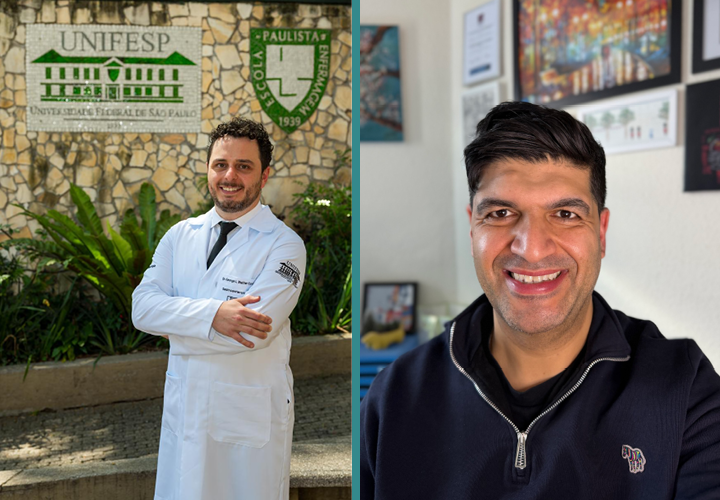
Image: George [left] and Ajay [right]
Between two approaches
Despite all these barriers, there are strengths in the Brazilian system. The sheer number of patients that we see, many of them with severe, refractory disease, provides an environment that teaches us a lot. Our residents gain exposure to complex, advanced cases early in their careers. We learn resilience, adaptability and to be creative with limited resources.
Learning more about the UK approach made me reflect. The NHS is not perfect, but the safety net of having multiple therapeutic options and a truly multidisciplinary team allows for more evidence-based and structured care. In Brazil, innovation often comes from necessity, but it also raises ethical questions: are we providing the best care or simply the best care possible within our constraints?
Ultimately, IBD knows no borders and the experiences of clinicians around the world can enrich each other. My day in Kettering General Hospital was not only a professional exchange, but also a reminder that medicine is practised within a social, economic and cultural context. Understanding these contexts is essential if we want to truly deliver equitable care for our patients with IBD across the world.
