

























Christopher Merrett was the first Harveian librarian at the Royal College of Physicians, appointed in 1654 after William Harvey left his library of several thousand books and collection of medical artefacts to the college.
Harvey’s home had been pillaged by Puritan forces in 1642 in retribution for his role as physician to King Charles I, so the college library could be seen as a safe haven for his collection. Physicians in the 17th century were expected to be ‘groundely lerned’ by studying the classics, literature, natural history, rhetoric and other scientific subjects – and Harvey’s extensive donation reflected this.
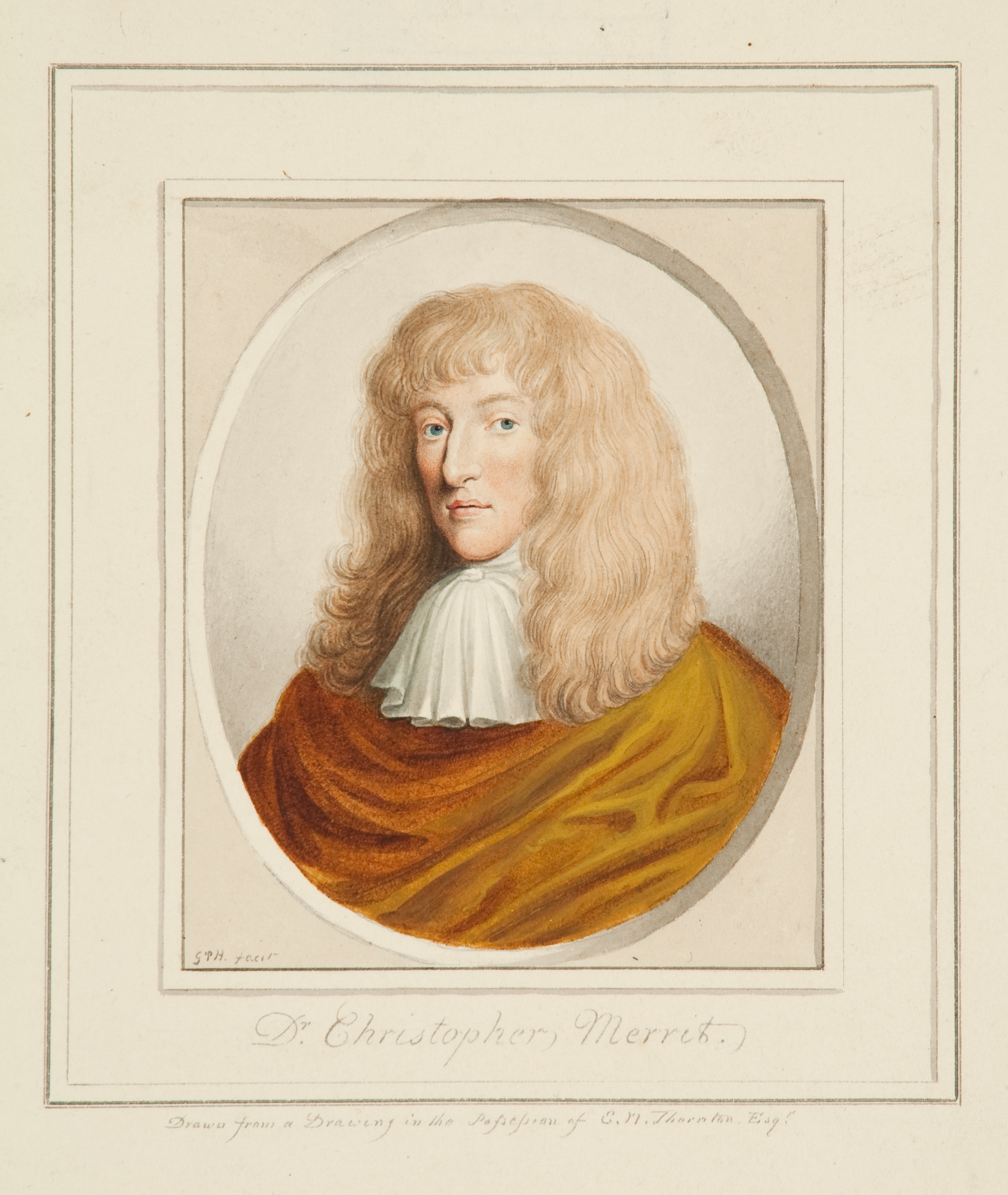
Image: Portrait of Christopher Merrett
Merrett had come to Harvey’s attention as a rising star of the college and Harvey personally recommended him for the position of the first ‘Harveian’ librarian. Alongside his college work in cataloguing the books and extending the library, Merrett became a member of the ‘1645 Group’ of radical thinkers including Robert Boyle, Christopher Wren, John Evelyn and Jonathan Goddard, who met at Merrett’s college rooms, among other London venues. This group eventually led to the creation of the Royal Society in 1660. As a founding member, Merrett was elected chair of the Royal Society’s committee on trades, a role that he combined fruitfully with college work, publishing a catalogue of British flora, fauna and minerals, papers on metal refining – and, most remarkably, a treatise on the double fermentation process to make wines ‘brisk and sparkling’, which was the first description of the production of champagne.
Tragically, on 4 September 1666 the college building, then sited at Amen Corner in the shadow of St Paul’s Cathedral, burnt down in the Great Fire of London. Anticipating the fire spreading on 3 September, Merrett had begun to set aside books and possessions that were a priority to be moved if the fire extended to the college. But in the path of the fireball that had consumed St Paul’s, the college’s home since 1614 stood no chance. Merrett was only able to save around 150 books, plus Harvey’s portrait which was cut from its frame, Harvey’s cane, a collection of archives, college annals and silverware. Years later, Merrett’s son Christopher described his father:
On the terrible night when the College caught fire … walking down Warwick Lane which was on fire on both sides, with arms full of books followed by bedel (college warden).
Christopher Merrett
Christopher Merrett's son
Surprisingly, Merrett was criticised by the college for not salvaging more library contents, although he had only one assistant to help him and the fire spread rapidly. He worked subsequently as a college censor, taking responsibility for enforcing the college’s remit on apothecaries. The original charter of the RCP gave it regulatory powers over the apothecaries who were expected to dispense medicines, but there was evidence that they were diagnosing and prescribing medicines too. In 1660, Merrett entered into a battle with the apothecaries with a paper, ‘A Short View of the Frauds and Abuses Committed by Apothecaries’ followed by the publication ‘The Accomplisht Physician, the Honest Apothecary, and the Skilful Chyrurgeon’ (surgeon) where he defined the roles of individual medical practitioners. This rigid demarcation was in line with the RCP’s views, with physicians firmly at the top of the hierarchy. However, it was seen as elitist and difficult to apply in practice, as there were insufficient physicians to meet the needs of the growing population, which had depended increasingly on irregular practitioners such as apothecaries, healers and other empirics – especially since the Great Plague in 1665.
In the spirit of experimentation advocated by the Royal Society, Merrett proposed two bold reforms – one was an overhaul of physician education, where he suggested that the principles of natural experimentation should be incorporated into physician training alongside Galenic teaching, which had been the cornerstone of practice for around 500 years. He further argued for a reduction in the period of physician education, with a greater focus on clinical training – with bedside exposure to patients with a variety of conditions.
In an attempt to reduce the influence of apothecaries, he suggested that students should be schooled in pharmaceutical medicine and in producing and dispensing medicines – taking on board the principles of artisanal practice that he had learned in his work in the trades section of the Royal Society.
Merrett was ahead of his time in terms of medical education, but ran into opposition from all sides. The traditional Galenists in the college objected to the new ideas of experimentation, and the modernists felt the that the reforms had not gone far enough in sweeping away stultified traditional training. Not surprisingly, the apothecaries were unhappy too. So Merrett’s reforms did not come to pass and in the 1670s he entered a protracted court battle with the college over the books that had been saved in the Fire of London. Merrett’s Harveian librarian post had been discontinued as there was no longer a library of substance, but he disputed this loss of role and kept the books that he had rescued as leverage. The college sued for their return and, after a series of High Court cases which Merrett lost, he was summarily expelled as a fellow of the college. In an additional blow, he was ejected from the Royal Society for non-payment of fees in 1685, probably related to large legal costs that he sustained in the court cases against the RCP. Merrett retreated to his home in Hatton Garden and continued as a practitioner, but a bright career had come to an ignominious end.

The full story of Merrett’s rise and precipitous fall from grace is told in this RCP Museum long read.
Some of the books that Merrett saved in the Great Fire of London and many more volumes from our rare books collection can be seen in the current RCP exhibition ‘A body of knowledge’, which describes 500 years of the doctors’ library; reflecting the books, their owners, authors and content – and the medical knowledge, practice and social values across the period. The exhibition is open to all until the end of July 2026.
Upcoming museum and garden events
A body of knowledge: woodcut print workshop
21 April | 6pm–8.30pm
We are delighted to be hosting London Drawing artist and expert printmaker Sisetta Zappone for an introductory workshop to woodcut printing this spring. Tickets are £28, with member discount ticket at £25 (use code RCP2026 at checkout).
RCP Museum Late: medicinal garden
6 May | 5.30pm–8pm
This May, step into spring with us for a free evening enjoying our medicinal garden and museum with expert tours and a special display of botanical books.
Plants and potions: children’s workshop
28 May | 10.30am–12.30pm
Create your own pomander, explore the plants of the RCP medicinal garden, get hands-on with medical history, and more in this creative half-term workshop. Tickets are £12 per child, adults go free.

Professor Anita K Simonds
Harveian librarian