

























What does it mean to work with some of the most vulnerable patient groups in the UK? Dr Rebecca Farrington, a GP with a special interest in asylum seeker mental health, works with the Greater Manchester Mental Health NHS Foundation Trust. She shares the unique challenges that she encounters in this role and how physicians can provide patient-centred care to refugees and asylum seekers.
How did you get interested in this area of medicine?
Kind of by accident. I worked with Médecins Sans Frontières for a few years in the 1990s, so I became aware of what horrible, nasty places refugee camps are and why people might want to escape from these situations.
I'm interested in other cultures and how health beliefs impact health-seeking behaviour, and how to be patient centred with groups that aren’t like me. I’ve become quite interested in cultural humility in medical education.
I think that how we treat the most vulnerable people in our society – the people that we offer sanctuary to – says a lot about our society. If we can get healthcare right for them, we get it right for a bigger population.
Can you tell me about your day-to-day work with asylum seekers?
My role has evolved over the years. I’ve worked overseas, but the current iteration of that is in Salford, Manchester.
My patients are mainly referred from GPs, but also from within the mental health trust and community organisations. I’ll see one or two new patients most days. We’re very lucky that the first appointment with them is an hour long, usually with an interpreter (which means that everything takes a bit longer). For a GP, that length of appointment is a fantastic amount of time, compared to 10–15 minutes.
Then I see patients for 30-minute follow-ups; the equivalent of 15 minutes, with an interpreter. I’ll check in with these patients; were the recommendations that I made to their GP enacted? Did the recommendations work?
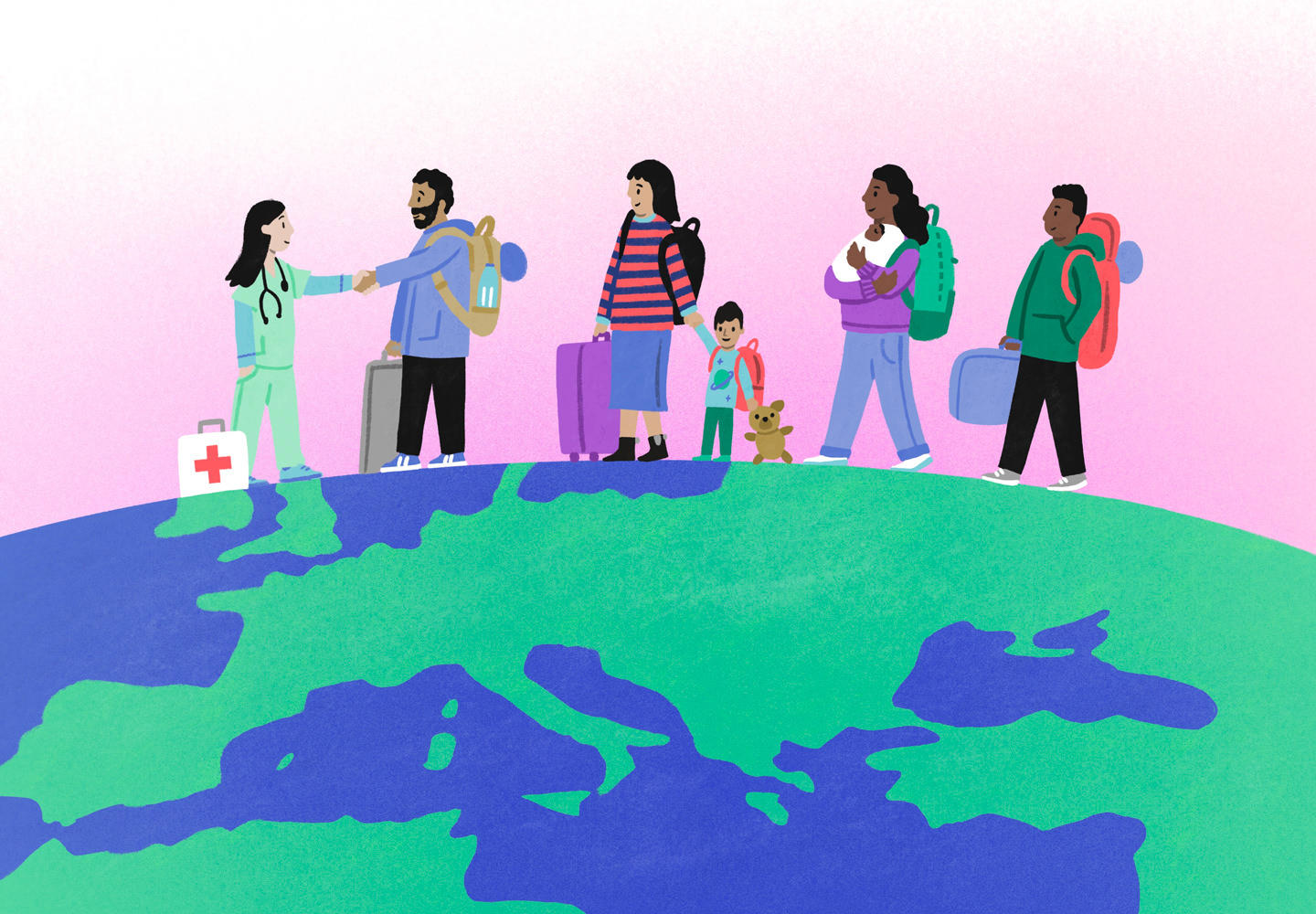
Image: James Gibbs at NB Illustrations
A lot of the focus is on how my patients feel about their immigration status; the wait to know whether they’ll be safe is the most stressful thing that they encounter. It’s hard to focus on other things when you’re unsure about the physical safety in your life. Trying to talk about long-term health is challenging when my patients aren’t sure where their next meal is coming from, or whether they’re going to get deported in an immigration raid tomorrow. I find that there’s a lot of trauma-related distress, depression, anxiety and PTSD – but a lot is distress around safety, and not having support through a distressing situation.
The other thing that I do regularly is advocacy. I write letters for patients, some of which will make a difference. Some of them won’t, but it will make the patient feel that I’m on their side and taking them seriously, which is a really important therapeutic tool.
I’m not there to judge their immigration claim; that’s not my role. I am there to listen, to hear the impact of my patient’s story as they perceive it and advocate on their behalf. My role is to let the Home Office know that the patient has symptoms that are consistent with their diagnosis; worries, fears and difficulties related to their circumstances.
How do you approach your first consultation with a new patient?
New patient assessments with asylum seekers or refugees take a bit longer than usual. Obviously, there are sensitive things to discuss – but also setting the scene for the patient; explaining the service, who I am, what will happen to their information (they’re always very worried about confidentiality), and explaining about how we work with interpreters.
I have to think about what experiences the patient may have had and how to sensitively approach topics – not just launching in, as that can be quite re-traumatising. These initial appointments have to be a gentle introduction, building trust and rapport. It’s person-centred, trauma-informed care; really thinking about how somebody might react to you as a stranger, as a person in authority – and their possible interactions with medical professionals in the past.
Many of my patients might not have routinely seen a doctor, or seen one only in an emergency – or they might have had much better access to medical services than we have in the UK! It’s important to not take anything for granted about what my patient’s expectations are.
Dr Rebecca Farrington
GP with a special interest in asylum seeker mental health
I think about the environment where we are working. It’s an office building – not very friendly or welcoming. I try to make the room a little bit more comfortable. Privacy and not being interrupted are really, really important.
Working through an interpreter is challenging. I’m lucky that I’ve managed to retain face-to-face interpreters most of the time, because so much communication is non-verbal. Visual things are really important; you see somebody looking away, breaking eye contact or becoming upset. The interpreter and I can manage that much better face to face.
What are some of the challenges that physicians might encounter when treating asylum seekers?
The level of poverty that many asylum seekers experience is important to consider; often they’ll be told by doctors that their child needs over-the-counter medicine, but that can be a whole day’s money. The GP surgery might write a letter advocating for housing or a health-related accommodation, but charge £60. It becomes out of reach.
For hospital doctors, there are slightly different challenges. My hospital colleagues worry about communication – getting hold of interpreters in the first place, having to rely on the telephone, what to do in an emergency when you haven’t got somebody speaking a patient’s language. Those things are challenging.
So is discharge planning, particularly for people who are homeless, with no recourse to public funds. Where do you send them? If you’re sending somebody home from an operation, are you discharging them to a park bench? Is that morally and ethically right in the sixth richest country in the world by nominal GDP?
Confidentiality is challenging across the board. Sustainable safeguarding for people is hard, particularly for those who’ve exhausted their appeals. You might get action in the short term, but in the long term, that tends to drop off. Home Office safeguarding teams and housing provider safeguarding teams are available to hospital or community clinicians – and they can be quite useful.
Charging for care is messy. There’s a very long government document on who’s chargeable and who isn’t; it’s really challenging to wade through. Essentially, all people seeking asylum are entitled to primary care and care for infectious diseases. But there are lots of areas that aren’t available – maternity care, caesarean section delivery and termination of pregnancy are all chargeable. There is a real gender bias and inequality.
We do see erroneous charging happen. I’ve certainly had patients who’ve been wrongly sent bills that they can’t pay – and then they get intimidating debt collector phone calls and letters. It has put people off seeking care.
People worry about being charged for a professional interpreter as well, which is a real deterrent to seeking care. They’ll offer to bring along family members, link workers or volunteers, who may be inappropriate as interpreters.

How does the stigma around asylum seeking impact health and social care?
There’s a lot more stigma around being an asylum seeker in the UK than there was, even 4 or 5 years ago. People are very reluctant to disclose their status as asylum seekers, so often clinicians treating them won’t know – and it is quite difficult to find that out.
Within society, the general opinion of who might constitute the asylum-seeking population is not always correct. There are not always sympathy and empathy in the general population – and of course, healthcare workers are part of that population, with a variety of political and societal beliefs around immigration.
There’s a lot of mislabelling of people. That impacts how healthcare professionals treat, see and communicate with patients – and it impacts on the likelihood of somebody accessing care in the first place.
Dr Rebecca Farrington
GP with a special interest in asylum seeker mental health
I see people having procedures done without informed consent, because there’s an assumption that the patient has understood the interpreter without it being checked. I see people making unusual decisions about care due to fear of how people will treat them.
Stigma also impacts on patients’ ability to complain or give feedback. I have encouraged people to complain [about inappropriate treatment they’ve received when seeking care] and they absolutely won’t, as they don't want to cause a fuss or trouble or bother – or to raise their head above the parapet and draw attention.
There’s a lot of misinformation in the media around why people come to the UK – it lumps asylum seekers together as one big group. Everybody gets lumped together under one label of ‘illegal immigrants’. It’s not helpful.
I really struggle with calling people illegal; I think acts and behaviours are illegal, not people. Often people are seeking, or on the journey to, legality.
How might physicians encounter asylum seekers in their practice?
Physicians will encounter asylum seekers in the same way that they encounter every other patient. It’s a human body; things go wrong.
You might not know straight away. If you have a patient who’s very reluctant to talk about where they’re from or why they’re seeking treatment, spending that extra time talking to them could be really important in building trust and continuity.
Asylum seekers have exactly the same medical complaints that everybody else does – but often neglected.
Dr Rebecca Farrington
GP with a special interest in asylum seeker mental health
Somebody who has had a 2-year journey across Europe without access to their medication is not going to have well-controlled asthma. Somebody with diabetes may not have had any choice over their diet or access to drugs for prolonged periods. People who’ve been living outside for long periods of time will have skin conditions, hygiene-related problems, burns and respiratory problems from cooking on smoky, open fires. This is often a young, sexually active population, so there are often people with vulnerable or high-risk pregnancies – sometimes a consequence of sexual assault in their home country or precarious sexual relationships in host countries.
Asylum seekers are not vectors of infectious disease. Sometimes that’s what people are interested in, but I don’t see huge amounts of infectious disease.
How can physicians best help asylum seekers in their practice?
Don’t make assumptions about who they are, why they’re here and what they might want or feel. Spend some time. Develop that rapport. Get that trust. Be explicit about who you are, why you’re there, what information you need, why you need it and what you’re going to do with it.
Proper interpretation saves time in the long run. Do it right. It’s the right thing to do, and medicolegally, it will protect you as a clinician. Your communication with your patient is patient safety.
One of the things that patients tell me is that they hate telling their story over and over again. It’s so re-traumatising. Remember that often people who are traumatised and have had violence perpetrated against them may have difficulty with shared decision making. They might be worried whether their response or decision is going to make that violence worse. Your patients also might be coming from cultures where doctors don’t always give them choices, so you’ll need extra time and information around shared decision making.
Think about the wider determinants of health. Somebody is not going to feel better while living in a horrible, cold, mouldy house, with flatmates banging on the walls all night, and no access to nutritional food.
If you’re in a leadership position, make sure that your team is being fair and not discriminating; that everybody understands that they’re not there to make judgement on somebody’s immigration status.
There are some pockets of really good practice. Some teams do amazing work with outreach, and lots of people do the best that they can. But it’s not well resourced and it’s often contingent on goodwill; often healthcare workers go over and above what they’re employed to do, because they can see the need.
There are a lot of people in healthcare, our colleagues, who are displaced or who’ve left their countries for various reasons. It’s great to support them as well.
Remember: most of the people that I meet want to contribute, want to work, want to get better, have an education, a family and have an ordinary life. The people who are seeking asylum can be the most interesting people you will ever meet. They’ve had to be incredibly resilient – they’ve had to live through, survive and sometimes even thrive after, unimaginable experiences.

