

























The chief registrar role is a senior leadership position that empowers doctors to drive meaningful change. Through this programme, chief registrars develop as clinical leaders while delivering improvement projects that enhance patient safety, streamline processes, and improve care standards across NHS organisations.
At the end of 2024-25 chief registrar year, the improvement projects were reviewed by a panel and shortlisted for awards within six categories.
Expand the categories below to view the shortlisted improvement projects:
Dr Charlotte Ainscough
The Chief Registrar Programme has significantly enhanced my leadership capabilities and confidence in delivering quality improvement within the NHS. Academically, it has deepened my understanding of leadership theory and practice, in particular understanding my own personality type and natural leadership style and the impact this has on working with others. I believe this knowledge will allow me to build more effective and empathetic teams, and tailor job roles to diverse strengths and communication styles.
Throughout the year I have worked on a variety of projects alongside my co-chief registrar at Barnet Hospital including; Improving Surgical Liaison services at Barnet Hospital, Introducing short form MEDL Guidelines for the management of medical emergencies, "RegReflections" which aimed to build a culture of collaborative working via regular cross-specialty meetings for all registrar grade doctors, organising various teaching days including a 4 day Compassionate Leadership Course. Alongside this, I have acted as a link between the resident doctor cohort and seniors, working on a variety of wellbeing improvements.
Most importantly, the Chief Registrar role has created the time and space for me to step back from day-to-day clinical work and reflect on how best to lead and influence. It has empowered me to contribute to positive and sustainable change within the organisation, equipping me with the insight, tools, and support to be an effective and compassionate leader in the NHS.
Dr Hannah Costelloe
I have really valued the opportunities I have had as part of the Chief Registrar Programme this year. Our training has helped me develop a greater understanding of dynamics within professional teams and my own role as a participant, influencer, and leader, within those teams. My growing awareness of management structures within the Hospital Trust and the interplay between the various roles has allowed me gain insight into the priorities of others' and helped me maximise opportunities to make change within the hospital, that I hope will be enduring. Empowering change within the context of the demands of a stretched NHS has required a lot of flexibility and willingness to try new things, but I have been fortunate to have worked within a very supportive organisation.
As part of the Chief Registrar role, I have improved my leadership skills. I think more about styles of communication and allowing space for all of the wide variety of individuals within teams to feel heard and involved, in order to achieve desired outcomes through collaborative effort. My knowledge of quality improvement has increased a lot over the course of the year and I have gained experience in leading improvement work amongst residents as well as using the results of improvement work in building business cases to drive further change.
Jermaine Wright
Quality improvement (QI) emphasises the importance of engaging a range of stakeholders. Before taking part in this programme, I had limited appreciation of this and assumed that stakeholder engagement was primarily about informing others of what was happening, rather than meaningfully involving them in the process. However, having since led and supported colleagues on several QI projects, I now recognise that this step is essential. In my experience, involving stakeholders has been beneficial in several ways: firstly, by offering valuable insights into historical context and helping to anticipate potential pitfalls; secondly, by identifying mechanisms to support long-term sustainability; and thirdly, by occasionally highlighting potential sources of financial support and helping to navigate bureaucratic hurdles.
This shift in perspective will undoubtedly shape how I approach and support QI projects in the future, ensuring that stakeholder engagement is embedded from the outset as a core component of successful improvement work.
Sarah Kate Duncan
The Chief Registrar Programme has been instrumental in shaping my development as a clinical leader and in enhancing my ability to drive quality improvement. One of the most significant aspects has been the increased self-awareness it has given me—particularly in understanding my own personality type, leadership style, and the strengths and limitations that come with them. This insight has helped me recognise how I influence others and where I need to develop further to lead more effectively.
Crucially, the time and support provided through the Chief Registrar role allowed me to invest in understanding the key issues affecting patients, resident doctors and the wider hospital, to speak to key stakeholders, and to build the relationships necessary to support collaborative and impactful quality improvement.
Mike Jones
Over the last 12 months the chief registrar programme has had a huge positive impact on my leadership skills. Through questionnaires it has been useful to identify my personality type and leadership style which has given me a broader understanding of how I might be perceived by others and how I may need to modify this for certain key stakeholders to get the best out of collaboration. It has also taught me how to design QI projects that support long lasting change as opposed to the 'quick and dirty' QI projects that we have typically done as tick boxes for portfolios. It's been a great year - thanks for all the excellent teaching!
I have found the Chief Registrar programme incredibly useful and informative. It has significantly improved my knowledge and confidence in managing projects and using QI framework. I have enjoyed the leadership types and personality trait teaching, and this has allowed me to reflect on my own leadership style. The feedback received from the action learning sets was always helpful. It felt very rewarding helping my chief registrar colleagues with their projects and helped develop my critical thinking and feedback skills.
I have found the Chief Registrar programme incredibly useful and informative. It has significantly improved my knowledge and confidence in managing projects and using QI framework. I have enjoyed the leadership types and personality trait teaching, and this has allowed me to reflect on my own leadership style. The feedback received from the action learning sets was always helpful. It felt very rewarding helping my chief registrar colleagues with their projects and helped develop my critical thinking and feedback skills.
During the Chief Registrar programme I have come to understand the differences in Leadership learning across different Specialities. For a number of the Chief Registrars much of the programme seemed to cover new concepts.
Interestingly, though perhaps unsurprisingly, within in Emergency Medicine there is quite a substantial focus on being a Leader and your role within a team. From a portfolio perspective we are also expected to lead on a Quality Improvement project which I had done as an ST5 with a multidisciplinary team focused on Sustainability improvements in the Emergency Department as part of a National movement, GreenED.
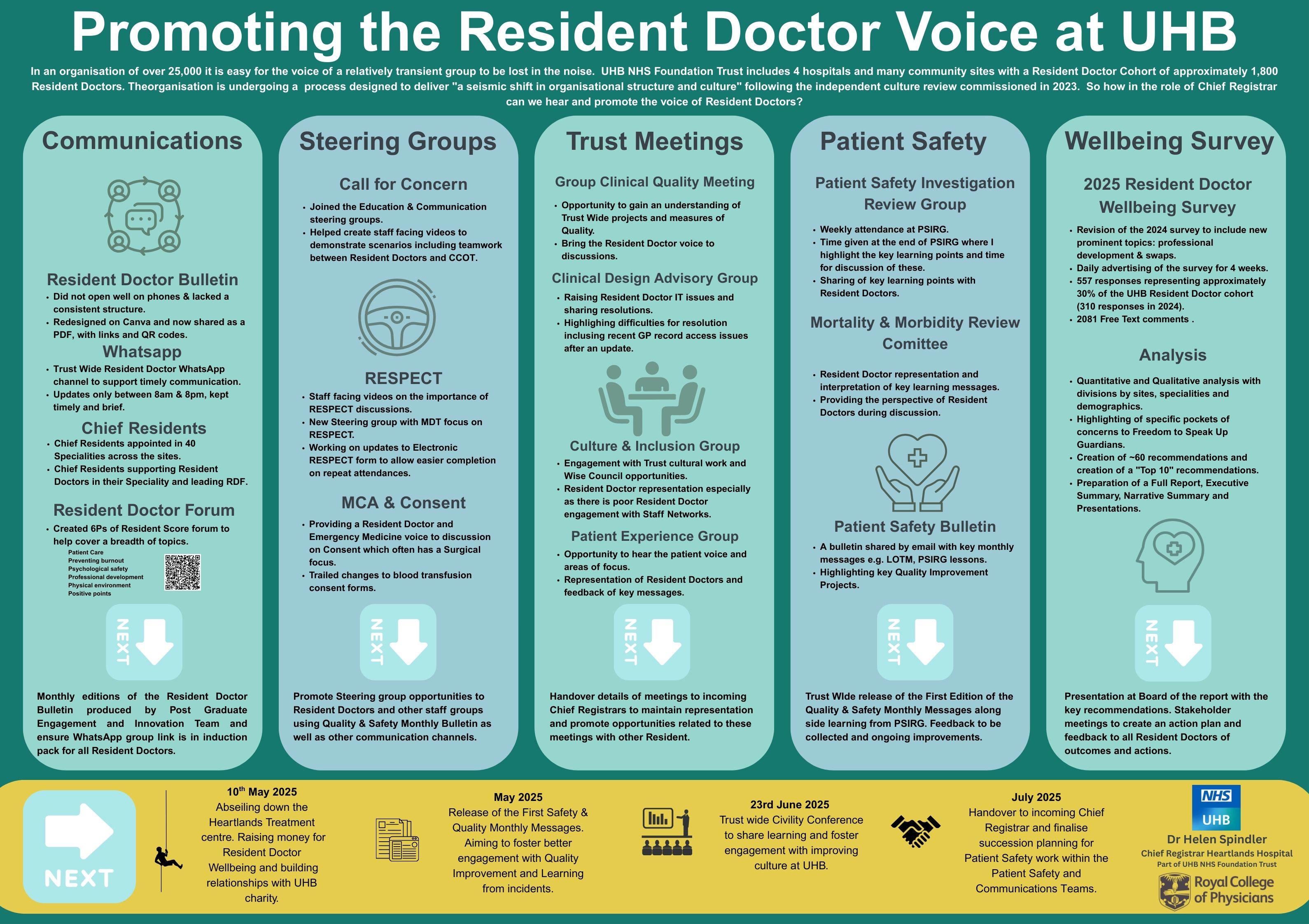
The part that has been new is understanding my role in the non-patient facing part of the Trust. An area I had not previously widely explored. Despite being a non-consultant, these meetings and steering groups have embraced my views and suggestions but all initially required a more gentle approach than my "ENTJ" style is accustomed to. I have been quiet! Held back! Occasionally embraced a silence! Built trust and become part of the furniture of these meetings. Don't worry my Leadership style didn't "hide" for long and I now have agenda items, presentations, requests for input etc. But it has certainly been a learning curve of carving out an identity of Chief Registrar Helen in a world outside of the Emergency Department.
It has given me confidence in my leadership skills on and off the shop floor and I look forward to taking my increased understanding of leadership styles, team dynamics and quality improvement into my future consultant career.
The Chief Registrar programme has been a unique and rewarding experience to better understand NHS organisational structures and processes, which will enhance my ability to enact change as I move into future positions of greater clinical and leadership responsibility. Prior to commencing the programme, I had to build quality improvement project and self-development time into a busy clinical schedule, which was often difficult with the relentless demands of specialist registrar training. The opportunity to have 50% of my working week protected for non-clinical duties has been a refreshing change of pace and enabled me to innovate in areas I am truly passionate about. The role has facilitated involvement in a number of diverse working groups covering patient safety, digital systems, e-rostering, postgraduate education, promoting training equality and patient flow. This has been accompanied by a portfolio of quality improvement projects that I have been entrusted to implement.
As Chief Registrar, I have had the platform to create steering groups for these projects and recruit motivated individuals to the team, who I have subsequently had the privilege of leading and mentoring through their own project journeys. Additionally, this year I have been challenged to adopt different methodologies and strategies to resolve complex organisational problems and reviewed how I manage people within a team to become a more consistent leader. I think the programme encourages you to step out of your comfort zone and explore the higher echelons of hospital management to diversify and develop professional qualities that will be invaluable as future health leaders. I would highly recommend this programme to all registrars.
The RCP Chief Registrar Programme has been such a positive experience for me. Over the year I have been able to develop my skills as a leader and confidence around leading successful change.
The first two modules centred around understanding self and others, for me, were the most useful for my specific project as the success was based almost solely on the developing strong relationships between partners in the integrated care system who do not interact directly with one another on a regular basis despite serving the same patient population.
Through learning activities, listening to others and discussion on the teaching programme I felt I was able to gain a deeper understanding of myself and as a result was more self-aware of my interactions with the wider project team and was able to lead more effectively.
Over time, working closely with my mentor (the medical director at my hospital), we were able to cultivate a positive culture within our newly formed team which was key to the success of the project and enabled us to provide optimum care for our patients.
Furthermore, through teaching around practical tools used to plan projects, understand and anticipate potential barriers and evaluate improvement, I felt more in control of the quality improvement project than I have previously done and consequently more confident of a positive result.
Finally, the biggest benefit of the programme for me was the inspiration gained working with tutors and peers. Understanding and learning from others spurred me on to really challenge myself to develop something positive that I felt truly passionate about. I hope to utilise the skills and enthusiasm I have gained for many years and in many future roles.
Participating in the Chief Registrar leadership programme has been a transformative experience, equipping me with the insight and tools to grow into a more effective healthcare leader. The protected time and high-quality teaching provided a valuable opportunity to reflect on my leadership style and better understand the complex systems at play in NHS change management. Engaging with senior leaders across my organisation has deepened my appreciation of their roles and responsibilities, offering inspiration and practical insight.
The programme opened doors to new opportunities, including completing a data analyst qualification that has enhanced the impact of my project work through more meaningful data interpretation. I’ve taken on leadership roles such as chairing the Resident Doctor Forum, contributing to a new EPR bid, and organising large-scale events like a Consultant application course, attended by over 120 delegates. Building relationships with like-minded peers across the country on the Course has been a highlight. This programme has thoroughly prepared me for the next stage of my career as a Consultant; I am very grateful to the RCP for the opportunity.
As a clinical leader, the Chief Registrar Program has been crucial in my growth as it has offered the chance, framework, and mentoring needed to spearhead significant transformation while still delivering frontline treatment. The program provided me an opportunity to engage in high-level conversations on clinical goals, patient flow, and service strategy. I learnt a great deal about how national NHS priorities and more general trust objectives match improvement projects. For instance, working on simplifying cross specialty referrals, I interacted with operational and digital leads to guarantee my project met more general goals including lowering delayed discharges and optimising bed use. I now see systems-wide thinking and sustainability planning rather than just individual repairs; I have become more strategically minded.
One of my major accomplishments as Chief Registrar has been creating and implementing a trustwide digital referral guide included into the EOLAS system. Using key QI techniques; stakeholder mapping, driving diagrams, PDSA cycles, and measurement for improvement. This project, at every level, I included co-design with feedback loops from digital developers, speciality teams, and resident doctors. Demonstrating a quantifiable, patient-facing impact, the intervention shortened referral delays, raised resident doctor confidence, and helped to ensure discharge e:iciency. The initiative greatly improved my capacity to bring colleagues from many departments and grades together. I oversaw group meetings including consultants, registrars, resident doctors, CNSs, and operational personnel. Learning to listen carefully, create consensus, and approach opposition with empathy helped me to become better able to interact and influence without formal power. At regional training committees and governance meetings, I also spoke for trainee voices advocating safer, smarter working conditions. Managing clinical responsibilities, QI leadership, and stakeholder management helped me to learn how to give long-term goals top priority, balance competing pressures, and stay focused. In my work, I become more introspective, aware of my own leadership style and places for development. Celebrating little victories, sharing accountability, and keeping flexibility in the face of unavoidable obstacles helped me also keep momentum without burnout. For emotional resilience and shared learning, the peer network the program offered was priceless.
The Chief Registrar Programme has changed my perspective on clinical leadership. Along with technical knowledge of QI and project delivery, I have developed confidence, insight, and strategic thinking to guide transformation that enhances staff experience and patient care. I am now eager to embark on this path, driving for more efficient systems and empowering others to do the same
The chief registrar programme has been brilliant for my personal development and leadership skills and has enabled me to lead on quality improvement through protected time for non-clinical work and the structured teaching programme provided by the RCP. The post has enabled me to shadow senior leadership meetings and learn from senior clinical leaders whilst also taking leadership roles on myself, which has provided a unique opportunity to reflect and build on my own skills. The training days have also been really helpful and being able to learn about QI methodology and discuss projects with peers has been invaluable in running my own QI projects.
Through the chief registrar programme I have developed a better understanding of the theory of leadership and the principles of quality improvement (QI) methodology.
During the RCP chief reg days, the learning around leadership theory was very effective: invariably it was possible to apply the theory discussed during sessions to recently lived experiences —whether from observing others in meetings or from reflecting on my own practice. It made me appreciate the variety of different styles and ways to lead a team effectively. I found it very humbling to exchange point of views and experiences with fellow chief registrars.
The learning about change theory -and associated behaviours- was also particularly interesting and useful to contextualise (and learn from) successes or failures within my projects. I have had the opportunity to try out a number of quality improvement tools, working on projects improving and have gained a good understanding of some of the QI methodology and its applications in the healthcare setting — whether that’s on a project looking at rota improvements, implementing in-situ simulation or introducing new community referral pathways for ED patients. The importance of having a strong narrative associated with QI has been an important learning point for me this year.
Working as a chief registrar has given me the time to work through problems thoroughly and to learn and practice QI skills. I have found working on providing sustainable solutions extremely rewarding! The support and ears I received from the wider hospital leadership this year have been invaluable resources. Coming to the end of this year, I feel more confident in my own leadership style and well equipped to lead and support QI on projects, and I am hoping to continue to effect change.
The Chief Reg Programme has been an amazing and really intellectually stimulating year. Having been involved in multiple projects, ranging from Patient Safety Investigations on mis-labelled blood samples to reducing unnecessary investigations to growing simulation within the Department and making improvements to the working lives of resident doctors, it has allowed me to meet and work with and learn from a massive variety of individuals. Understanding the theory behind Quality Improvement has sky-rocketed my ability to plan a project and even meant I have been able to offer feedback and teach these skills to others!
At a personal level, I have experienced a cognitive switch towards thinking around Emergency Medicine at the bigger picture level. This invaluable experience has allowed me to see where the Emergency Department fits into a tertiary centre Trust and the management-level viewpoint. Attending Trust and regional Emergency Care meetings have shown the multitude of other services involved in providing patient care. This year has overhauled the way I view Emergency Medicine and significantly altered (hopefully improved!) my day-to-day practice in the ED.
I am extremely proud to have been selected for the Chief Registrar Programme. This year has given me the tools, opportunity and motivation to take the lead on a project I care about. It has enabled me to vastly expand my professional network and have the opportunity to be mentored by, and learn from, inspirational leaders. I never saw myself as a leader in the traditional sense before this year, I feel more capable, and proud of my achievements. Thank you RCP.
The Chief Registrar Programme has significantly developed my leadership skills and ability to lead quality improvement through structured training and practical application. Across the year, through this RCP course and working alongside colleagues in my Trust, I’ve gained a deeper understanding of leadership structures and processes within the NHS, particularly the challenges faced by mid-level leaders who are often clinicians by background.
Analysing team dynamics using the Belbin model and reflecting on my own MBTI profile has improved my self-awareness and interpersonal communication. This has already proven useful in both clinical and non-clinical scenarios. These tools, combined with training on influencing styles, have equipped me with strategies to lead change confidently and deliver effective quality improvement projects in my organisation.
I have thoroughly enjoyed my year as the chief registrar at Chesterfield Royal Hospital. The Chief Registrar Programme has furthered my knowledge around the quality improvement process and the different techniques to analyze and interpret data.
Main projects:
1. Medical handover:
I have led on a project to improve the medical handover at CRH which has involved the introduction of registers to record attendance and to gather information about role allocation/ highlight any issues encountered when on an on call shift. As part of this project the handovers have moved to a central location with more emphasis on using IT to flag unwell patients across the trust. I have also led on introducing 2pm huddles to all medical wards to ensure that the MDT are updated about management plans and to flag patients for potential afternoon discharges.
2. In situ simulation
I am passionate around medical education and simulation, to empower teams to feel more comfortable in the recognition and management of the deteriorating patient. I have developed a programme of insitu simulation on the medical wards to provide short simulation sessions based on MET call data. This programme has empowered resident doctors to feel more confident in managing acute scenarios i.e.) seizures.
3. IMG Induction Programme
I have been involved in a project improving the induction for international medical graduates (IMG’s) where we have developed a weekly teaching programme to IMG’s that are new to the trust to improve their transition to the NHS. Topics covered include ward work, RESPECT, portfolio/career development and clinical skills updates. I have developed a mock interview programme for resident doctors applying to Internal Medicine Training where >50% of those who attended were offered an IMT place.
The Chief Registrar programme has allowed me to learn more about my leadership style and develop my communication skills across a wide range of settings. The programme has given me a subset of skills to get the best out of the teams that I work in, and to navigate the changing landscape of the NHS.
The programme has given me the confidence to come out of my comfort zone and lead from the front to generate positive change in the organisation that I work in.
Hear from a chief registrar
Dr Wakana Teranaka attended the Chief Registrar Programme 2023 – 24. Hear why she decided to join the programme and how the Chief Registrar Programme supported her in her role in the videos below.
- Why did you decide to take on the role of a chief registrar and join the programme?
- How has the Chief Registrar Programme supported you in your role?
- What impact do you think you had in the organisation?
- How did the programme support you to implement a QI project in the workplace?
