


























In December, the RCP hosted its annual Peers’ breakfast at the House of Lords. The Peers’ breakfast gives the RCP the opportunity to bring together senior officers, special advisers and members of the House of Lords to discuss our members’ priorities.
This year, the theme of our breakfast was ‘the power of prevention’. Peers heard from, and spoke with, our special advisers on air quality, obesity and tobacco. We sought to set out the RCP’s priorities around these policy areas and demonstrated how peers could better support the RCP’s calls from parliament.
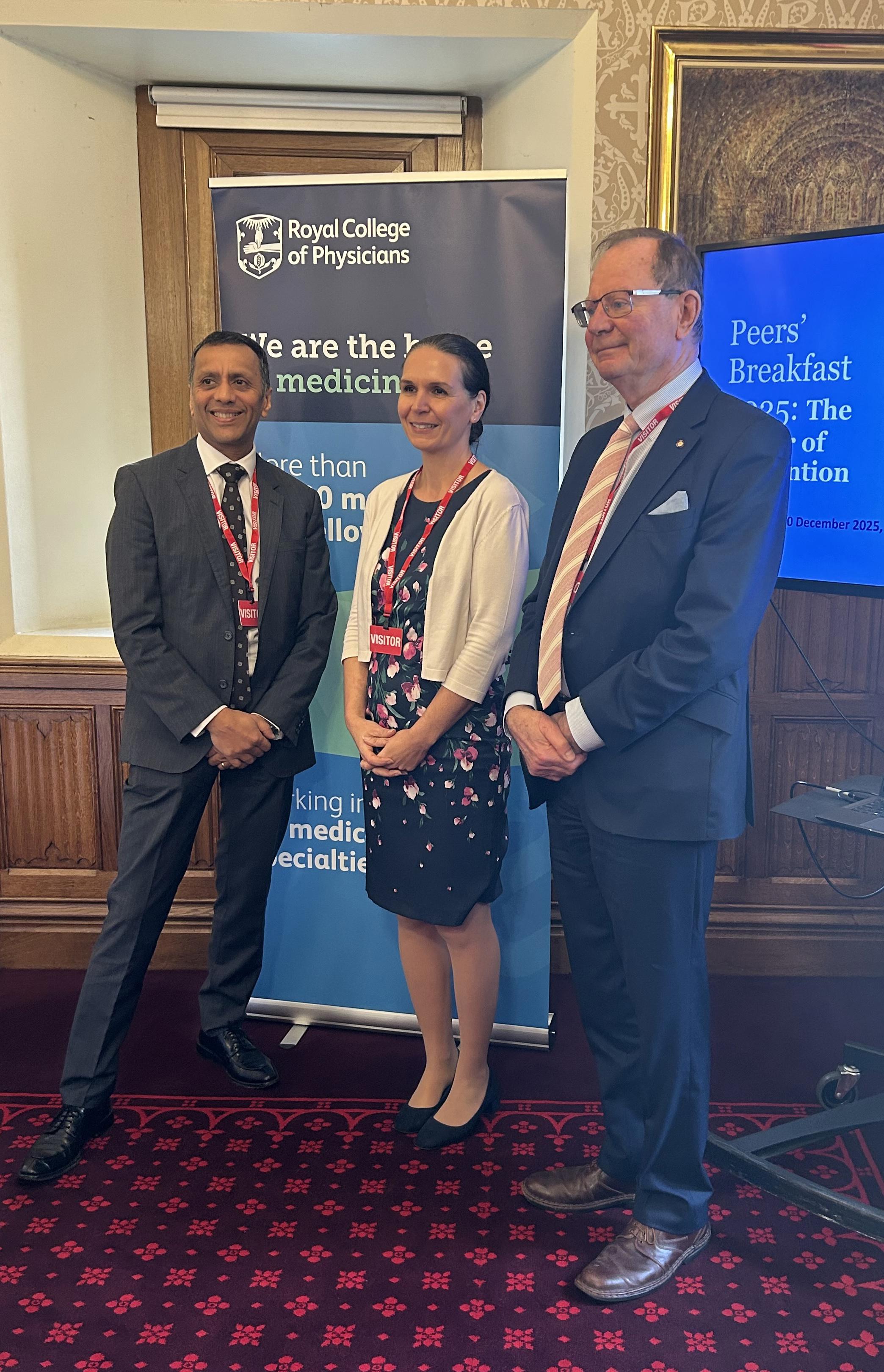
RCP special advisers at the event. Left to right: Dr Sanjay Agrawal, Dr Kath McCullough and Professor Sir Stephen Holgate.
Prevention as a focus
The RCP has a long history of leading public health advocacy. Over 60 years ago, our landmark 1962 report on smoking was the first such publication to definitively state the link between tobacco smoking and lung cancer.
Today, prevention remains an RCP priority, as we continue to campaign on preventable ill-health and the public health response. In 2025 we published a new report outlining the harms of air pollution, a new position statement on obesity and gave evidence to the public bill committee for the Tobacco and Vapes Bill.
Professor Mumtaz Patel, RCP president, opened the event by outlining the experiences of members, saying that the impact of the social determinants of health is something that physicians are increasingly seeing in their practice. Our recent snapshot survey of our membership, carried out in June, found that 94% of over 500 physicians see patients whose conditions are caused or worsened by smoking, obesity or alcohol dependence.
Social determinants of health are systematic drivers of ill-health and inequality. While the 10 Year Health Plan acknowledged the role of the social determinants of health, we are yet to see a comprehensive plan for tackling them. At the Peers’ breakfast, the RCP stressed to peers that we would like to see decisive, cross-government action on prevention, which will improve public health.
Air quality
Professor Sir Stephen Holgate, RCP special adviser on air quality, stressed that air pollution is ‘one of the biggest threats to human health’ and must be treated as a health issue – not a solely environmental one.
Peers were moved by the findings of our June report, A breath of fresh air, which highlighted the health harms of air pollution. It estimated that around 30,000 deaths will be linked to air pollution in 2025 and that the annual cost to the government is £27 billion. It also found that pollution affects every organ in the body, damage starts before birth, worsens chronic conditions and contributes to dementia.
We encouraged peers to hold the government to account on its pre-election commitment to bring forward a new Clean Air Bill, as part of its health mission.
Obesity
Dr Kath McCullough, RCP special adviser on obesity, spoke about obesity being ‘one of the UK’s most pressing health challenges’ and urged peers to advocate for further action towards tackling the root causes of public health.
We highlighted the results of our snapshot survey, which found that 80% of physicians who responded have seen more patients with obesity over the past 5 years. Nearly half reported that obesity reduces the effectiveness of treatment for other conditions.
As obesity is strongly linked to deprivation and driven by wider social factors like unequal access to health food and physical activity, tackling it will require more than just individual actions or weight loss treatment. Wider action is needed to create an environment where healthier choices are available for all.
We asked peers to push the recommendations of the House of Lords Food, Diet and Obesity Committee’s report, Recipe for health: A plan to fix our broken food system. These include there being a comprehensive food strategy, mandatory regulations for business and healthier local food environments.
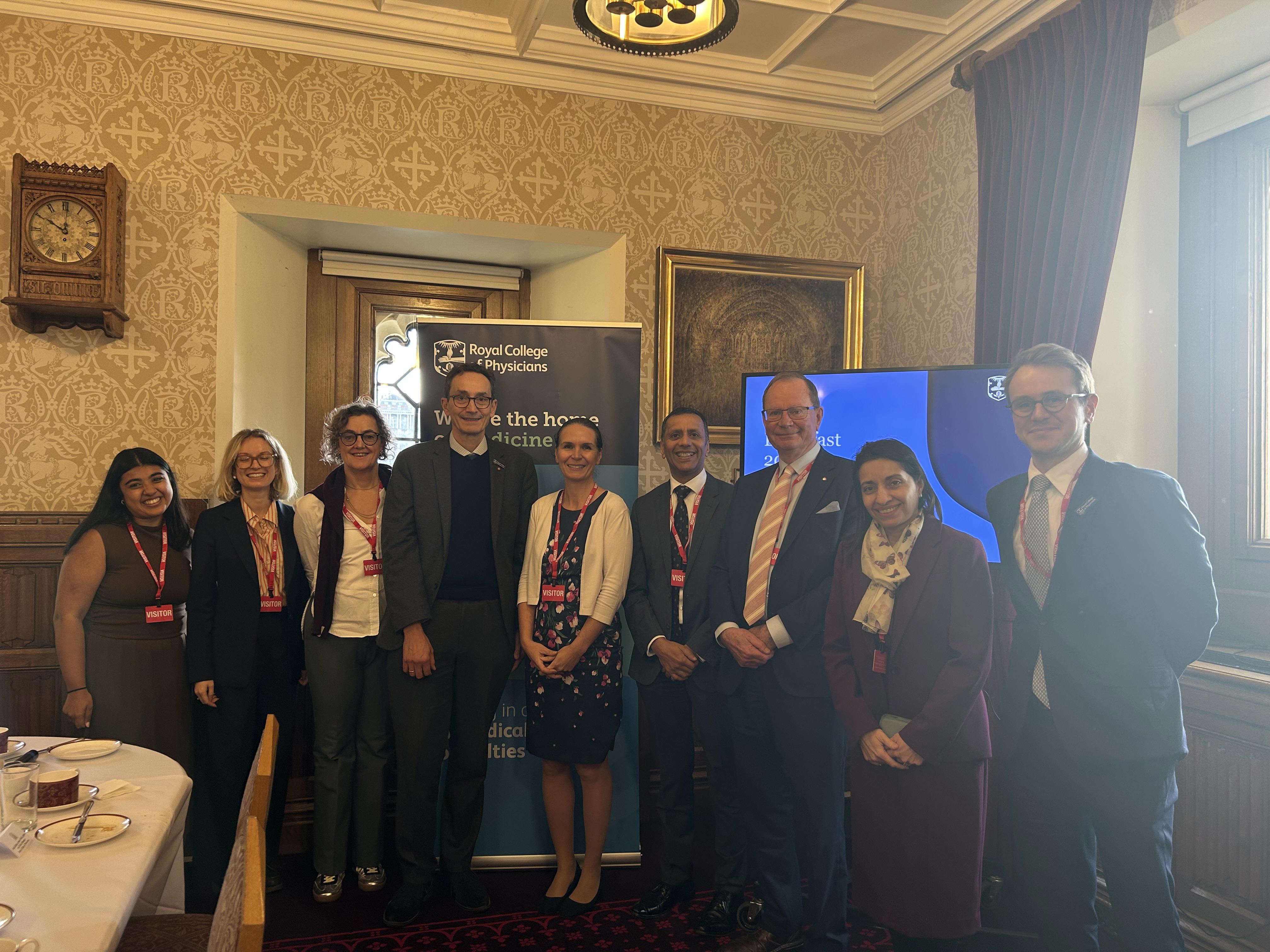
The RCP team at the House of Lords.
Tobacco
Professor Sanjay Agrawal, RCP special adviser on tobacco, stressed that smoking is ‘a public health crisis driven by addiction, inequality and industry tactics that strip away personal choice’.
We demonstrated to peers the impact of smoking, with it being the leading cause of preventable illness and death globally. In our snapshot survey, 53% of respondents said at least half of their average caseload was made up of patients whose conditions have been caused or exacerbated by smoking.
Professor Agrawal also discussed vaping and its role in harm reduction by drawing on our 2021 report that found e-cigarettes are more effective than patches or gum tobacco cessation, but after that, patients should also seek to quit vaping to avoid unknown harms. We outlined our concerns around the rise in youth vaping and that this being driven by child-focused marketing.
We urged peers to support the Tobacco and Vapes Bill’s progression through parliament, and to speak and vote against harmful amendments to the bill.
Next steps
The RCP will continue to build on this engagement with peers in the House of Lords, working with them to ensure that the views and experiences of RCP members are heard within the legislative process.
If you would like to keep updated on our policy and campaigns work, or would like to support further, you can sign up for our fortnightly RCP Digest email.
Correction 12 February 2026: The initial article stated that we encouraged peers to hold the government to account on its manifesto commitment to bring forwards a new Clean Air Bill. This has been corrected to say that we encouraged peers to hold the government to account on its pre-election commitment to bring forward a new Clean Air Bill, as part of its health mission.
