


























Adults who sustain a bone break after minimal trauma often have life-changing loss of independence, persistent lower quality of life and increased mortality. Half of all adults aged 50 or over who break a bone after minimal trauma are at high risk of another fracture in the next few years.
Professor Kassim Javaid, clinical lead for the Fracture Liaison Service Database (FLS-DB), shares the findings of its recent, based on 2024 data, 'Steps to fracture liaison service effectiveness: importance of treatment recommendations', with Commentary.
Fracture liaison services (FLSs) are NHS teams that reduce the risk of future fractures in adults aged 50 or over who have recently sustained a fracture. Patients are identified, assessed and receive appropriate treatment to lower their risk of future fractures. FLSs are based throughout the UK and bring clear benefits to patients and the healthcare system. Despite overall progress across many indicators, significant variation remains across FLSs.
The FLS-DB is a clinically led national audit of secondary fracture prevention in England and Wales, run by the RCP as part of the Falls and Fragility Fracture Audit Programme (FFFAP).
Our challenge is to translate the effective care for some to effective care for all, through better local leadership and accountability: sharing good practice and data-driven service improvement and development in order to deliver prevention, community-based care and digitalisation within the NHS.
What is the Fracture Liaison Service Database?
The FLS-DB is national audit run by the RCP that captures data of patients aged 50 or over who experience a fragility fracture, with the aim of preventing any future fractures. A fragility fracture is a fracture that occurs from standing height or less and can include hip, spine, humerus and pelvic fractures.
Seventy-seven FLSs across England and Wales actively participated in the FLS-DB audit in 2024 and contributed towards the annual report. 83,500 patient records were submitted in 2024 and compared with 2023 patient data. In this year’s annual report, we focus on whether the fracture patients at highest risk of osteoporotic fractures are prioritised and provided with appropriate treatment to prevent future fractures, in line with NICE guidance.
Key findings
Performance trends: 2023 vs 2024
A key part of the FLS-DB annual report is its annual comparison of service performance.
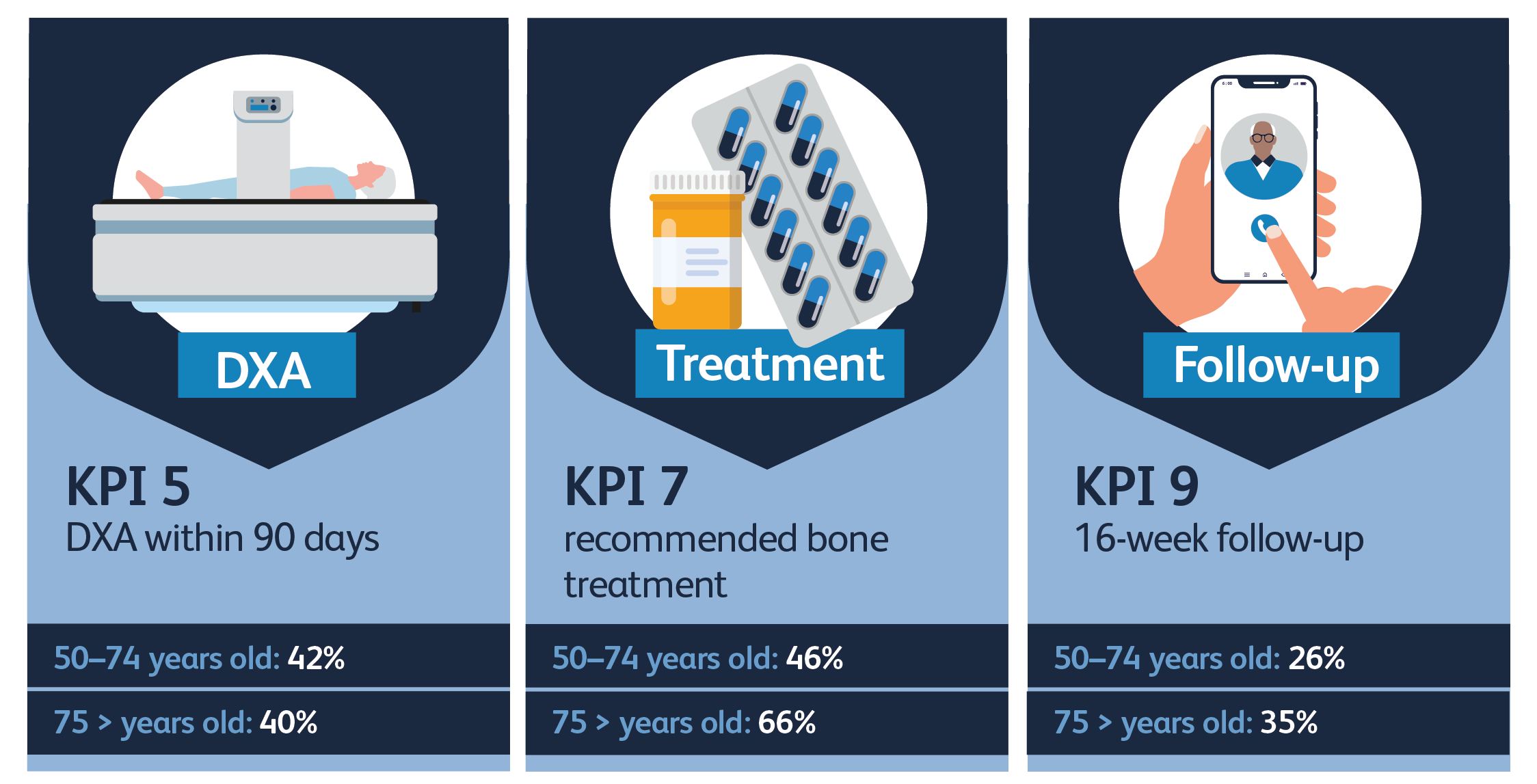
This report saw notable differences in performance. In 2024, the identification of patients with non-spine fractures decreased to 50%, from 55% in 2023. However, the identification of spine fractures increased from 34% to 38%. The percentage of patients assessed by an FLS within 90 days of their fracture increased from 65% to 69%. There was also a modest increase in falls assessment in 2024, with 62% of patients receiving an assessment compared to 60% in 2023. The number of patients recommended bone therapy marginally decreased from 59% in 2023 to 57% in 2024.
In addition to the analysis of patient data, the FLS-DB also conducted a facilities audit to create a detailed national picture of how secondary fracture prevention is being delivered. 51 sites took part. In total, 21 FLSs reported that they had no administrator sessions and 17 had no consultant sessions as part of their service. 13 FLSs were not taking part in any formal governance meetings and 43 did not include patients as part of their governance structure. These data demonstrate clear barriers and opportunities for FLSs.
Impact of health inequalities
Health inequalities contribute to poorer health outcomes and preventable health conditions and mortality. Patients from lower-income households are at a higher risk of experiencing hip fractures and face poorer outcomes following identification – including less timely health assessment, falls assessment and lower monitoring. The report analysis also highlights differences in performance for England vs Wales, by sex and by age.
Overall, FLSs in Wales identified more spine fractures than England. However, England had higher non-spinal fracture identification. Wales also achieved higher results in assessing patients within 90 days (81% vs 68%). Adults aged 75 years and over were slightly less likely to have a DXA scan within 90 days, compared with patients under the age of 75. Patients under the age of 75 were less likely to be followed up at 16 weeks, with little difference at 52 weeks (13% in Wales vs 14% in England).
What’s new?
- This year we have included five graphs in appendix A that compare identification and treatment recommendations by FLS, showing unreasonable variation in care depending on local practices.
- In 2024, the FLS-DB extended its online reporting to include service-level and integrated care system (ICS) data on the number of patients who are not receiving the FLS-DB standards for identification, initiation and continuation of appropriate secondary fracture prevention, including areas that do not participate with the audit.

'This annual report celebrates the step change in secondary fracture prevention delivered through FLSs in England and Wales. The variability of care delivery between FLSs clearly demonstrates how FLS can be delivered effectively in the NHS. Our challenge now is to translate the effective care for some to effective care for all through data-driven service improvement and service development using the shifts of prevention, community-based care and digitalisation.'
FLS-DB clinical lead
Professor Kassim Javaid
Dr Kassim Javaid
Clinical lead for the Fracture Liaison Service Database (FLS-DB)