

























Empowering staff-led action through a champions network to drive greener care and embed sustainability across a large NHS trust.
The issue
At Imperial College Healthcare NHS Trust, there is a small sustainability team of 2.8 FTE, but it is a large trust with over 16,000 staff across multiple sites. There is a challenge to engage staff in a supportive manner, while overseeing and coordinating many green projects across clinical and non-clinical areas.
The solution
A Green Champions Programme was created to enlist staff to represent their areas of work across the trust. This programme built on an existing staff green community network and aimed to enable staff who wanted to be more actively involved in green projects. We engaged with staff to determine the essential ingredients for delivering the programme as a trust-wide rollout.
Essentials:
- Open to all staff in all roles and seniorities, clinical and non-clinical.
- Recommended protected time but not mandated, or an amount prescribed to maintain flexibility at the line manager’s discretion.
- Support from trust Sustainability team: Monthly champions check-in online, and 1-1 calls where needed.
Support for green projects:
- Recognition with blogs, articles, social media and email mentions in trust comms.
- Merchandise, where available, as a thank you.
- Celebration of wins and promoting social connections with other champions.
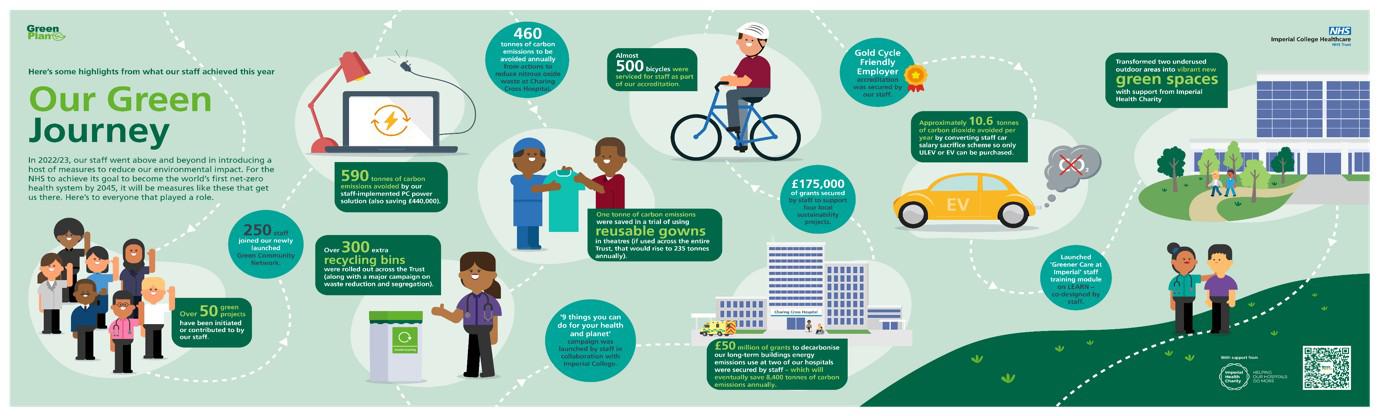
A green community network was already formed to keep staff in touch and raise awareness of the trusts Green Plan, including the green actions and projects that had been initiated. Membership of the network has successfully grown to 700+ staff from 2022–24. However, we observed that some of the staff members in the network were highly active, while most simply wanted to stay informed, and as such the subset of more active members needed to be better supported. The Green Champions Programme was launched in April 2024 to support this subset of staff and to enlist more representatives for greener care in their local areas of work.
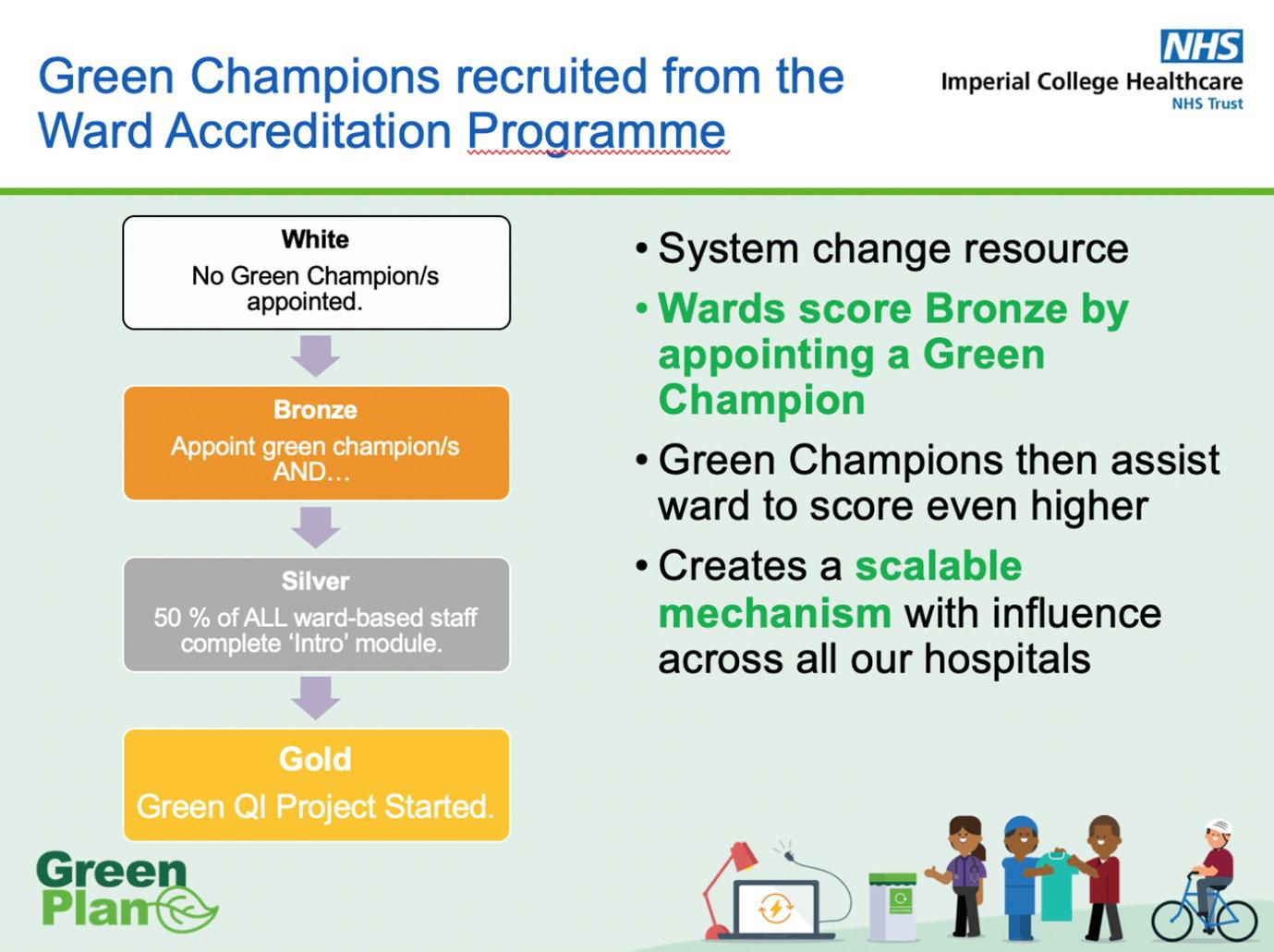
The launch of the Green Champions Programme was embedded into the trusts new Green Plan scoring section of the Ward Accreditation Programme – this programme scores wards across multiple performance areas to continuously improve care quality. Each category is scored as bronze, silver, or gold. For a ward to score bronze in the Green Plan, they must appoint a green champion, resulting in a powerful recruitment mechanism for this role.
Within 15 months of launching, in July 2025, more than 100 green champions were registered across all areas of the trust, including hospital sites, directorates and satellite services.
The impact
- Reduced emissions from clinical waste, contributing to an increase in clinical waste segregated into Tiger bins (non-infectious OW) from 22% to 45%+. Tiger clinical waste has 50% less greenhouse gas emissions in disposal than Orange (infectious) clinical waste.
- Multiple green projects initiated autonomously by green champions, such as maternity outpatients prescribing, ‘Rub don’t scrub’ in theatres, and multiple staff at different levels introducing more reusables in green theatres or decommissioning nitrous oxide manifolds.
- Engaged green champions are the green team’s eyes and ears on the ground who have reported both opportunities and issues around sustainability at the grassroots level in wards, other clinical areas and offices.
- Expanded the number of inhaler recycling drop-off locations across our three main sites to 11 locations and promoted these to our staff.
- Secured approval to pilot an innovation to switch the gas used in cryotherapy machines in the Western Eye Hospital from nitrous oxide to carbon dioxide.
- Expanded the number of walking aid drop-off locations to cover three main sites, collecting 957 walking aids, with around 80% being re-issuable.
- Removed paper couch rolls in physiotherapy MSK outpatients, estimated to reduce paper use of 20 rolls per month which equates to around 75 kg CO2e, and obtained support from infection, prevention and control director to remove paper couch rolls in most areas across the trust.
- And many more…
Conclusion
The green team is aiming to have around 250 green champions representing all areas of the trust before 2027.
Key take-home messages:
- Co-create your essential programme ingredients with existing staff who are active in sustainability to generate more buy-in.
- Leverage any existing community or communications to promote.
- Give green champions permission to act semi-autonomously to act rapidly at scale without requiring hierarchical oversight from trust green teams who have limited resourcing and bandwidth.
Contributors: Dr Gareth Thompson (Sustainability clinical and innovation lead), Darshan Patel (Sustainability Programme manager), Dr Bob Klaber (Net Zero Board lead)
Institution: Imperial College Healthcare NHS Trust